
What a Utah County Resident Lookup Covers
Different records confirm different parts of a person’s public trail. Property records connect owners to parcels. Voter records provide public registration status and selected fields. Xchange identifies public case entries, not a current address. Vital records use relationship, identification, record age, and legitimate-interest rules. Historical directories, obituaries, cemeteries, DOPL, and business filings can add dated context.
| Record | What It Confirms | Where to Search | Access |
|---|---|---|---|
| Land Records | Owner and parcel connection | Utah County hub | Free online routes |
| Voter registration | Public status and listed fields | Utah voter search | Protected fields withheld |
| Court records | Public cases, parties, and dispositions | Xchange | Search and image charges |
| Vital records | Birth, death, marriage, divorce | Utah OVRS | Eligibility and age limits |
| Licenses and entities | Professional or business identity | DOPL and Commerce | Public lookup routes |
Use the name form first when the person is tied to land, the voter search when a current registration question is lawful, and Xchange when a case number or court matter is the subject. For family history, begin with the city directory, obituary, cemetery, or archive. A single record is a lead, not a verified identity.
Utah County Court Search Fields
Xchange lets a researcher narrow a Utah County name by jurisdiction, search type, case number, last name or company, first name with wildcard, case type, scope, birth date, citation number or location, and filing, disposition, judgment, or judgment-disposition dates. Fewer than three characters cannot be combined with a wildcard, and broad searches can return up to 500 results.
| Result Field | What It Can Mean |
|---|---|
| Court and county | Where the case was entered |
| Case type and number | Record category and stable case key |
| Filing and disposition dates | When the case or outcome was entered |
| Party and party code | Role in the public case record |
| Case history and documents | Events, public filings, orders, and available images |
Guest access, searches, and document images have separate charges. Public terminals at most district courthouses are a fallback. Sealed, private, expunged, juvenile, adoption, and several family-related categories are excluded or limited. A case result is not current-address proof.
The Xchange help capture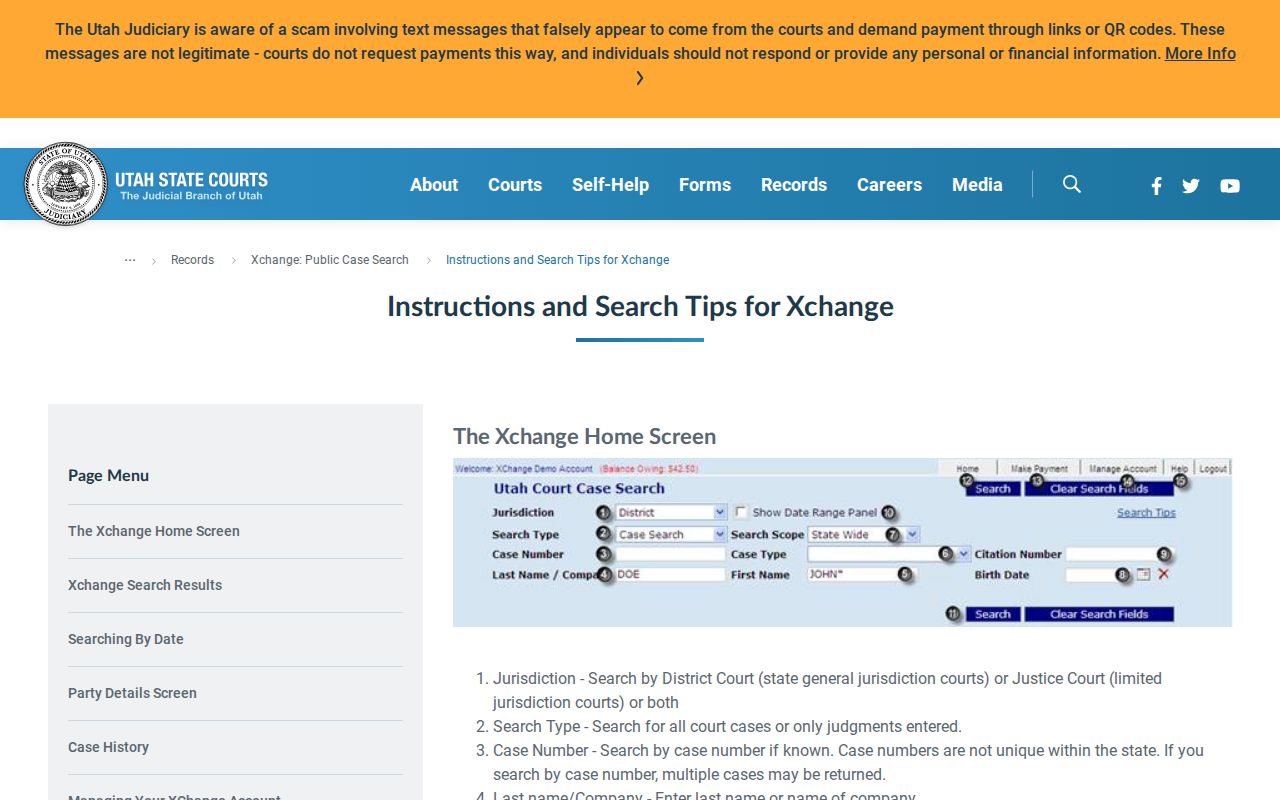 shows the field set and result anatomy behind a Utah County resident lookup.
Untangle Same Names in Utah County
Same-name errors are common when a name is short, a middle name is absent, or a result crosses several courts or cities. Start with the strongest anchor available: a parcel serial, a city, an address, a court location, a dated occupation, or a family connection. Compare the exact source fields rather than treating a shared surname and first name as one person.
The property system separates situs from owner mailing address. The voter system may show public address, precinct, party, districts, and age range while withholding full birth date and other identifiers. A directory may list a business or boarding address. These differences let a researcher reject a tempting but weak match.
Save the search date, source URL, displayed name, city, record type, and result date. If a match still cannot be resolved, stop at “possible” instead of merging records into a composite profile.
Verify a Utah County Resident Record
A careful resident lookup uses one source to anchor the name and another to test it. A parcel or public voter result may supply a city or address. Xchange can expose a case party and disposition. An archival vital image, directory, obituary, or cemetery record can add a dated family link. The goal is a supported record citation, not a larger collection of personal details.
- Anchor the name to a city, parcel, public address field, dated occupation, or family relationship.
- Run Xchange across the proper jurisdiction and search the name with careful variants.
- Compare case dates, party role, court, and public history with the known anchor.
- Use Utah OVRS or an archive only when relationship, ID, record age, and lawful access support the request.
- Order a certified copy from the custodian when the task needs proof rather than an index lead.
- Docket
- The dated case history showing filings, events, orders, and other public entries.
- Index vs image
- An index points to a record; an image is the scanned or filed document and may carry a charge.
- Certified copy
- A custodian-issued copy marked as an official copy, subject to that record’s access rule.
Utah Vital Record Eligibility
Utah OVRS covers births from 1905 forward and current death, marriage, and divorce certification routes. Current access is controlled by relationship, acceptable identification, record age, and a direct, tangible, legitimate interest or another statutory basis. Utah Code §26B-8-125 generally makes birth records public after 100 years, death records after 50 years, and other vital records after 75 years.
The birth application lists Self, Parent, Sibling, Spouse, Child, Grandparent, Grandchild, and Other relationship choices. It asks for printed name, phone, address, email, number of certificates, signature, date, and total fee. The first search or certified copy is $22, additional copies $10, and expedited service $15, with nonrefundable fees. One primary photo ID or two secondary IDs may be used under the acceptable-ID rules.
The vital-records capture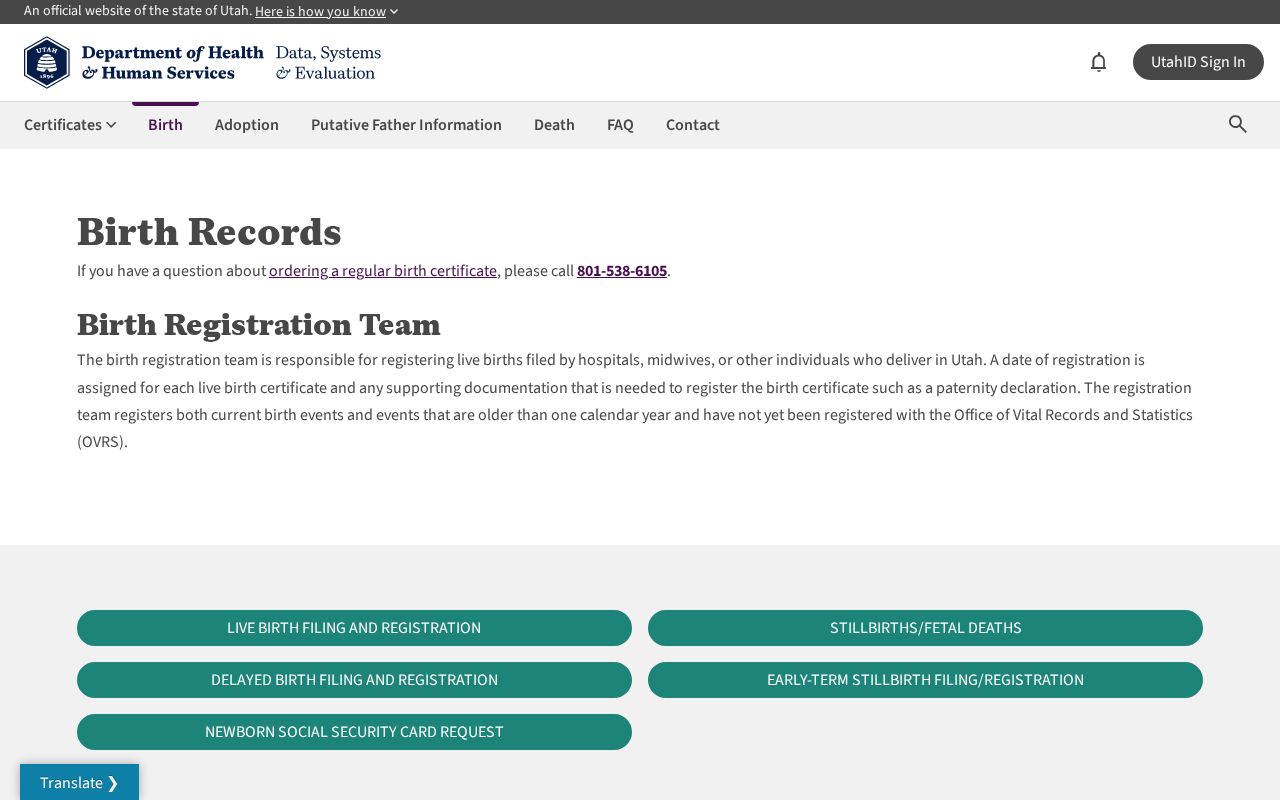 leads to the official access route. It is safer to record a record’s age and eligibility basis than to assume a name search can reveal a current person.
Historical Names Need Date Context
Provo City Library’s obituary index covers Utah County newspapers from the 1870s to the year before the current year, but the index gives the newspaper and date. The full notice requires microfilm or a digital newspaper page. The library holds the Daily Herald and predecessors back to 1888, with missing early issues; its request form asks for the deceased’s full name, death date, delivery preference, and comments.
Provo cemetery records can add birth, death, parents, grave, physician, cause, and remarks depending on the historical series. Utah Archives holds birth and death registers from 1898–1905 and marriage applications. Those sources support family history and dated corroboration, not a current residence claim.
The Utah County court-directory capture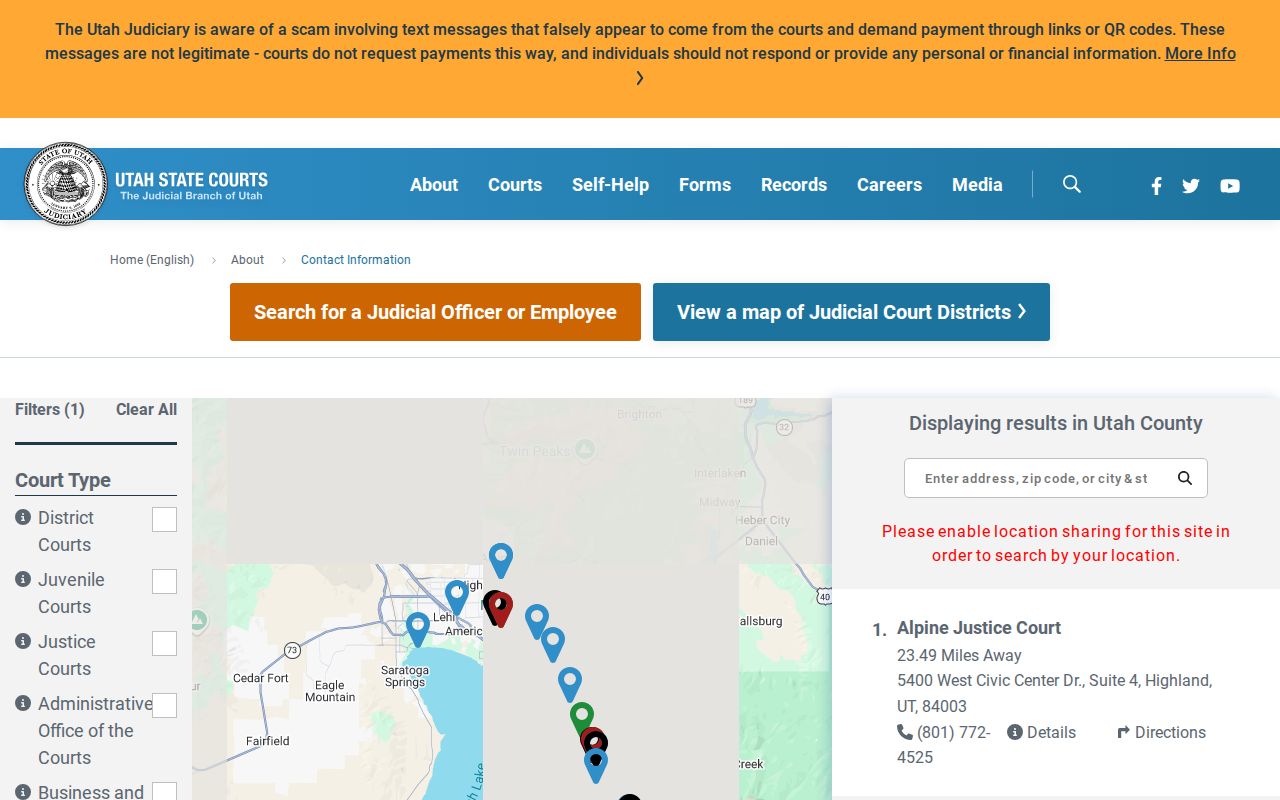 helps identify the right court location before a case search or courthouse-terminal visit.
The Provo historical-search guide is a good route for obituary, newspaper, and founder research. Test initials, maiden names, OCR errors, and abbreviated streets, then read the full page around an apparent hit.
License and Entity Corroboration
DOPL’s free public lookup searches by name and profession or license number. Results can show licensee name, city, profession, number, and status. Use all-license search because a lower-numbered license can be expired or superseded. A license city is a professional record field, not proof of a home address.
Utah’s entity search accepts all or part of a business name and can lead to filing history and principal details. MyCash unclaimed-property search uses last or business name with an optional first name, but a hit does not reveal a current residence. Cross-check a name with a parcel, case, directory, cemetery, or voter source before calling it the same person.
Search the DOPL license lookup and keep the profession, city, status, and search date in the citation.
Legal Limits on a Utah County Resident Lookup
GRAMA begins with a public-record presumption, but Utah records can be private, controlled, protected, sealed, or restricted by a specific statute. Safe at Home provides a substitute state address for eligible survivors, and At-Risk voter protections can suppress identifying data. A missing result may be a safety protection rather than an identity failure. Do not use another source to defeat a confidentiality program.
Lawful use. A Utah County resident lookup is for personal, lawful research, family history, civic review, and reconnecting. Using records to stalk, monitor, harass, intimidate, or harm anyone is unsafe and may violate Utah law.