
Utah County City Directory Collections
Utah County’s historical city directory shelf is centered on Provo, but the title often reaches beyond Provo city. The 1891 sample includes Provo, American Fork, Lehi, Payson, Spanish Fork, and Springville, plus officers, neighborhoods, and agricultural or property notes. The collection is therefore a county research aid, not a narrow city-only roster.
| Collection | Years | Where Held | Access |
|---|---|---|---|
| Polk’s Provo City and Utah County Directory | 1917–18 to 2004–present, with gaps | Provo City Library | Library holdings and local-history access |
| 1884 Utah Gazetteer and Directory | 1884 | Provo Special Collections | Historical reference volume |
| Utah City Directories digital collection | Varies by volume | University of Utah | Searchable digital collection |
| U.S. City and Business Directories | Varies by image set | FamilySearch | Account or affiliate access may apply |
The Provo holdings list 1917–18, 1920, 1922, 1926, 1929, 1930–31, 1935–36, 1939, 1941, 1944, 1946, 1950, 1953, 1955–62, 1964–65, 1967–80, 1982–85, 1987, 1996, 1998, 2000–02, and 2004–present. Missing years are part of the evidence. Do not smooth the gaps into a continuous run or assume a publication stopped when the shelf simply lacks a volume.
Where Utah County Volumes Sit
Provo City Library is both a local-history repository and a research desk. Its local-history book list identifies the Polk holdings and the early gazetteer. Its obituary route places Daily Herald and predecessor microfilm on the second floor of the Rogers Wing, where patrons can scan, print, or save pages. Library contact is 550 N University Ave, Provo, UT 84601, 801-852-6650.
The shelf is most useful when the researcher records the volume year, page or image, exact entry, and whether the line says residence, boarding, business, or institution. If a scan is not online, ask the library for the volume or use the official request route. BYU and Utah Valley University are additional institutional repositories for specific newspapers, yearbooks, oral histories, and campus collections, but an old affiliation should not be treated as a current address.
The library-holdings capture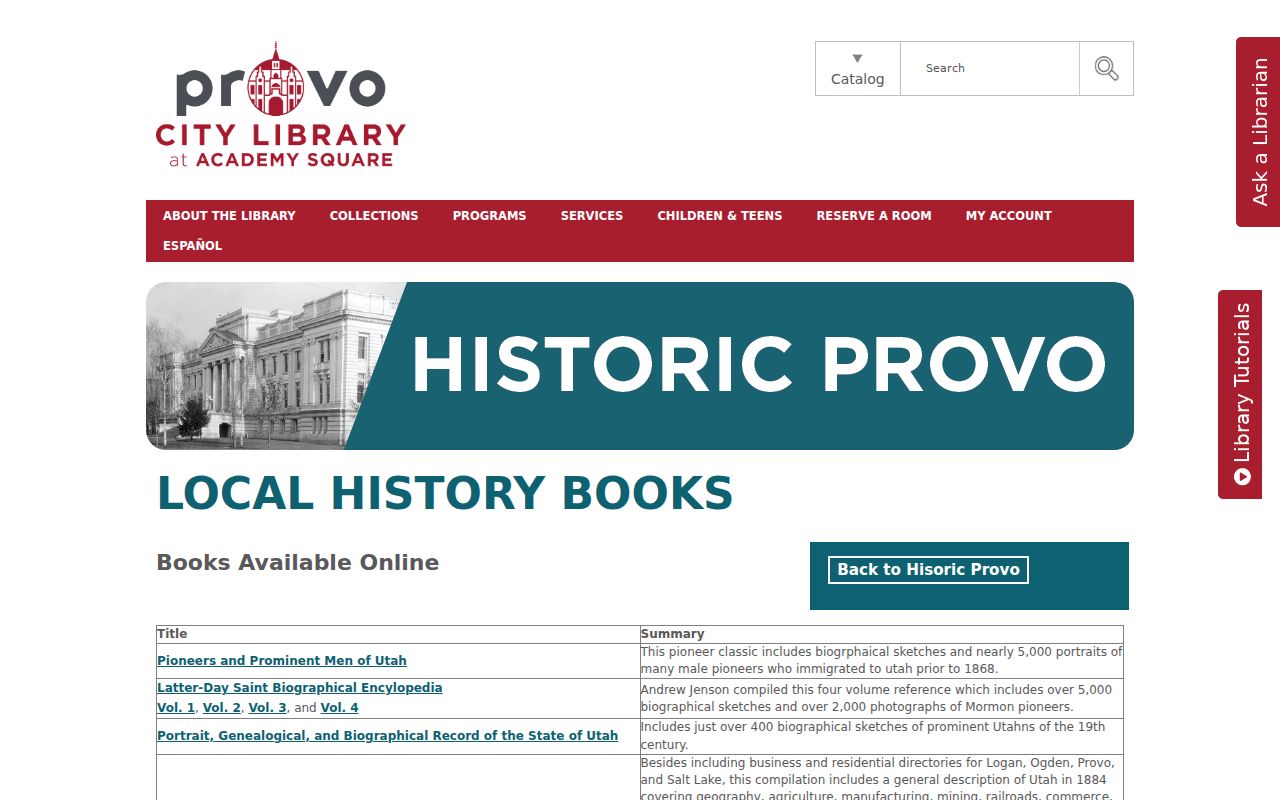 connects the shelf list to the official local-history page.
Digitized Utah County Directories
The University of Utah Utah City Directories collection is the strongest digital route located for Utah County work. FamilySearch also offers a U.S. City and Business Directories collection with indexed names, occupations, and addresses across approximately 1.296 million images. Availability may require an account or affiliate-library access. Cite the collection, volume, page or image, and access date.
A digitized 1891 Provo and Utah County sample names multiple Utah County communities and helps define the geographic reach of the title. A genealogy transcription can be a finding aid, but a scan or library holding should support a quoted name or address. Search surname variants, initials, maiden names, and OCR alternatives before deciding a family disappeared.
Open the digitized Utah city-directory collection for volume-level search. The historical city directory route is stronger when an image citation sits beside the transcription.
Reading a Utah County Directory Entry
A city directory entry is compact. The name may be followed by an occupation, employer or institution, residence, business address, spouse or widow notation, and sometimes a marker for boarding or rooms. The 1904–05 sample shows Oscar W. Flygare as a machinist connected with Provo Woolen Mills and residing at 110 S 8th West; other entries separate business and residence or show a widow boarding at an address.
| Name | Listed person, with household or spouse clues when printed |
|---|---|
| Occupation | Work or institutional connection |
| Address | Residence, business, boarding, or rooms, as marked |
| Status note | Marks such as widow, boards, rooms, or residence |
| Source detail | Volume year, page or image, and original spelling |
- Criss-cross section
- The street-order half of a directory, used to move from an address to listed names.
- Householder index
- An alphabetical or address aid centered on the person responsible for a listed household.
- Abbreviation key
- The volume’s guide to short forms such as res, bds, rms, agt, carp, and s/e directional marks.
Utah County Directory Abbreviations
Photograph the abbreviation key before reading a page. The 1904–05 material uses forms such as agt for agent, appr for apprentice, av for avenue, bds for boards, carp for carpenter, mach for machinist, PO for post office, res for residence, rms for rooms, s for south, and e for east. Expand a mark only when its meaning is plain from the volume.
Address evidence depends on the label. “Res” points to a residence. “Bds” means boards, which is not the same as ownership. A business listing may sit at the same address as a home, but the line should not be converted into a household claim. Keep the printed form and your explanation side by side.
The Provo local-history capture links the guide to the library’s newspaper, obituary, founder, and pioneer research routes.
Utah County Directory Timeline
The holdings do not tell one smooth publication story, but they do show several useful eras.
- 1884: the Utah Gazetteer and Directory includes Logan, Ogden, Provo, and Salt Lake City.
- 1891: a Provo and Utah County volume reaches several county communities.
- 1904–05: entries show occupation, residence, business, boarding, and abbreviation conventions.
- 1917–1987: Polk holdings recur across listed years, with visible gaps and multi-year volumes.
- 1996–present: later holdings resume in selected years and then continue from 2004.
Use the timeline as a way to choose the next shelf or scan, not as proof that every year had a volume.
Use Utah County Directories for Family History
A city directory is strongest when several years are compared. Track the name, address, occupation, spouse or widow mark, and whether the line says residence, boarding, business, or institution. Pair a directory year with a census year to fill a decade gap, then use newspapers, cemetery records, or an obituary to test what happened after the last listing.
- Start with a surname and variants in the alphabetical person or business section.
- Record the first dated appearance, then compare the next available volume rather than assuming an absent year.
- Check the street or criss-cross section for the address and nearby listed names.
- Pair the directory date with a matching census year, keeping the census address and household fields distinct.
- Use the obituary index, cemetery map, or archival vital image as a dated endpoint.
Disappearance can mean a move, death, a missing volume, a spelling change, or a person who was not listed in that edition. A newspaper, cemetery entry, deed, or later directory can narrow the explanation. The Provo obituary request page describes Daily Herald microfilm, scans, and copy choices, while the obituary index gives the newspaper and date rather than the full article.
The obituary-request capture shows the library’s route for a dated newspaper copy.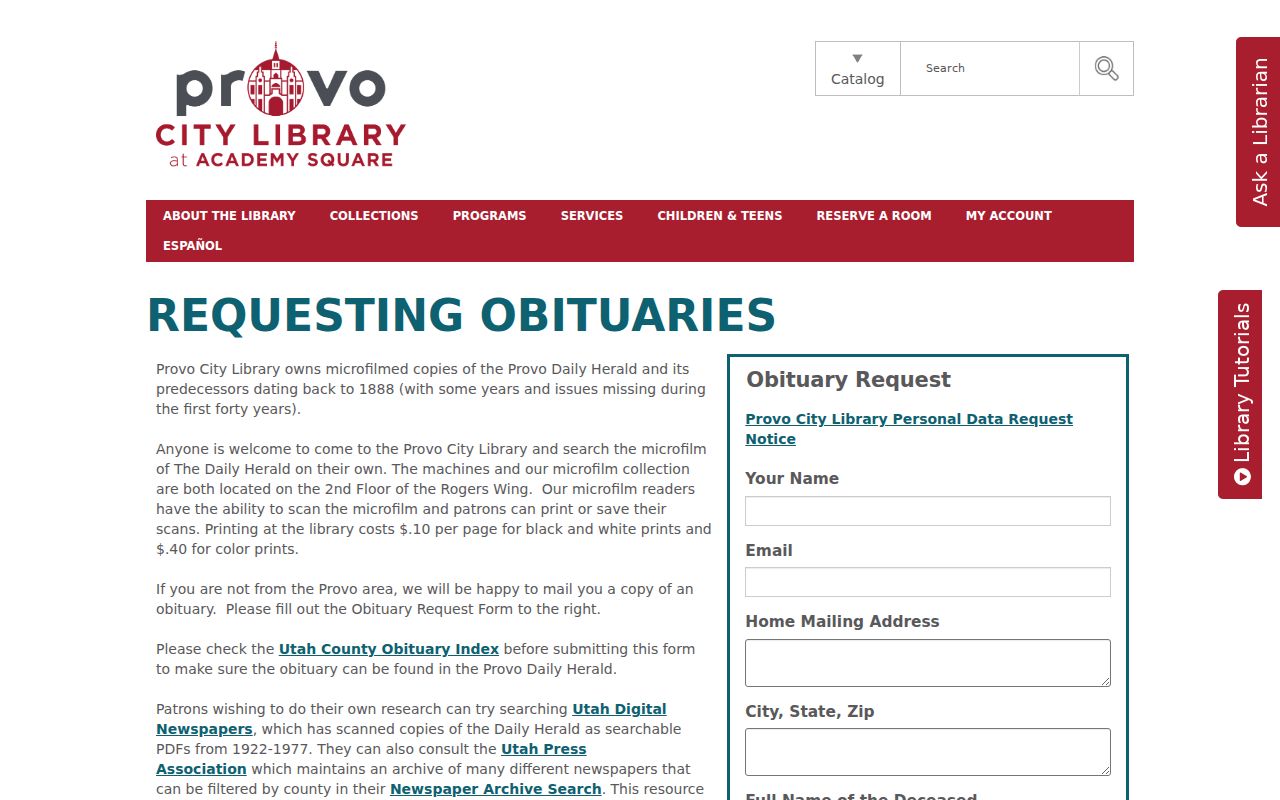 A newspaper notice can support family history, but it remains a published source that should be labeled and checked.